
Free 9th-Grade SHSAT Vocabulary Flashcards
The 500 words that matter most for 9th graders taking the SHSAT for 10th-grade admission, turned into 1,500 flashcards that practice vocabulary the way the SHSAT tests it: in Reading Comprehension passages and Revising/Editing questions. Made by Dr. Stuart Donnelly for his own students, and free for every family.
- 500 words
- 1,500 cards
- Audio for every word
- Anki + Quizlet + PDF
Three Cards for Every Word
Each word builds from “I know what it means” to “I can use it on test day.”
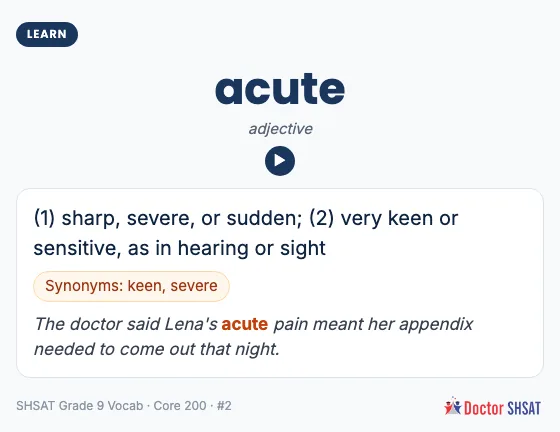
Learn the word
Hear the word spoken aloud, then flip for a plain-English meaning, synonyms and an example sentence.
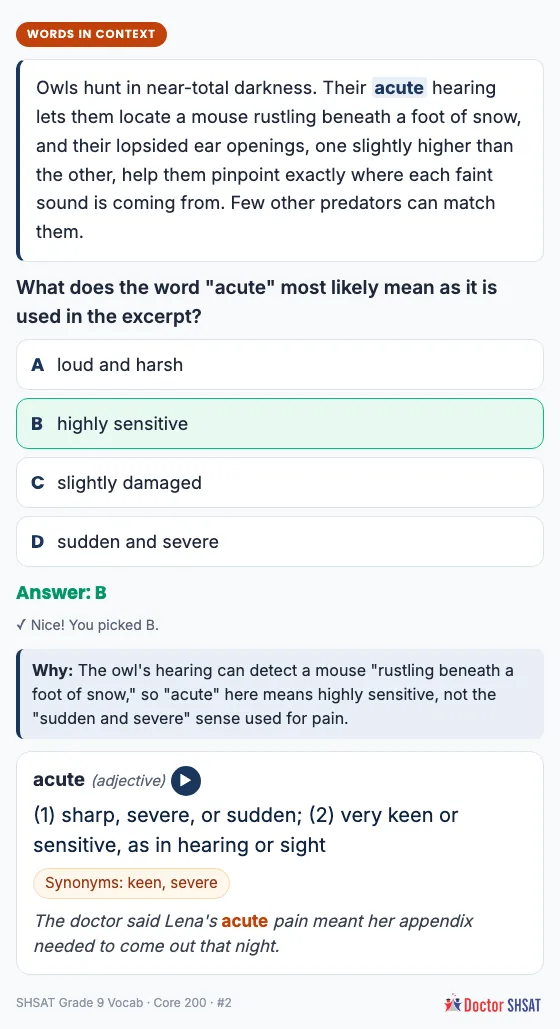
Words in context
A short passage and a “what does this word mean here?” question, just like SHSAT Reading Comprehension. Many words are used in a less familiar sense, the way the test likes to use them.
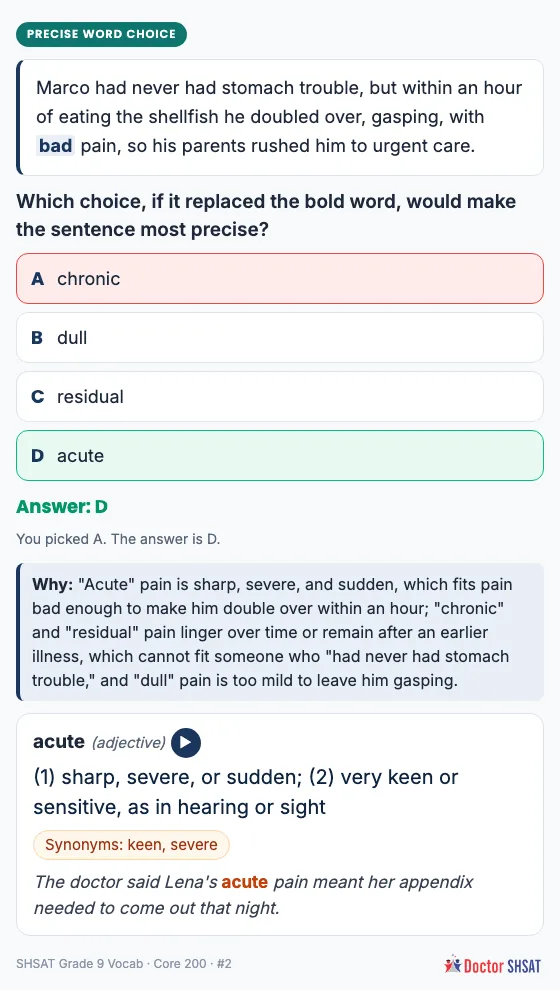
Precise word choice
Replace a vague word with the most precise one, like the word-choice questions in SHSAT Revising/Editing. The answer side explains why.
Why Vocabulary Matters on the SHSAT
The SHSAT has no separate vocabulary section, but words decide a lot of ELA points. The ELA section has 50 Revising/Editing and Reading Comprehension questions, and the Reading passages include challenging literary and informational texts. Students who stop on every unfamiliar word lose time and meaning.
Two kinds of questions test vocabulary directly: Reading Comprehension asks what a word means as it is used in a passage, and Revising/Editing asks which word makes a sentence clearer or more precise. These flashcards practice both. See the SHSAT ELA section guide for how the whole section works.
- Every question was checked. Each of the 1,000 practice questions was answered independently and checked against the answer key. Choices that could be argued as a second right answer were replaced.
- Built for 14- and 15-year-olds. Plain-English meanings and original passages on science, history, the arts and New York life.
- Spaced repetition in Anki. Each word comes back just before it would be forgotten, so 10–15 minutes a day goes a long way.
SHSAT 9th-grade Vocabulary List: All 500 Words
Every word in the deck, A to Z, with a plain-English meaning and synonyms. Start with the Core 200, then move on to the Extension 300. Prefer paper? Download the printable PDF word list.
Core 200 start here · the most useful words
- abstain v. to choose not to do something, especially not to vote or not to have something you want (refrain, hold back)
- acute adj. (1) sharp, severe, or sudden; (2) very keen or sensitive, as in hearing or sight (keen, severe)
- adept adj. very skilled at something (skilled, expert)
- adverse adj. harmful or unfavorable; working against you (unfavorable, harmful)
- aesthetic adj. having to do with beauty or with how something looks (artistic, visual)
- affirm v. to state firmly and publicly that something is true, or to show support for it (declare, confirm)
- alienate v. to make someone feel unwelcome or turn away from you (estrange, drive away)
- allocate v. to set aside or hand out something (money, time, space) for a particular purpose (assign, distribute)
- aloof adj. cool and distant; not friendly or involved (distant, standoffish)
- ambiguous adj. able to be understood in more than one way; unclear (unclear, vague)
- ambivalent adj. having mixed or conflicting feelings about something (torn, uncertain)
- amend v. to change something, such as a law or document, in order to correct or improve it (revise, modify)
- analogy n. a comparison between two things that shows how they are alike, often used to explain something (comparison, parallel)
- apathy n. a lack of interest, concern, or feeling (indifference, unconcern)
- appease v. to calm someone down or satisfy them, often by giving them what they want (pacify, soothe)
- appropriate v. (verb) to take something for your own use, usually without permission (seize, take over)
- arduous adj. very difficult and tiring; requiring great effort (grueling, strenuous)
- arresting adj. (adj) so striking that it grabs your attention (striking, eye-catching)
- assimilate v. (1) to become part of a new group or culture; (2) to take in and fully understand information (integrate, absorb)
- attribute v. (verb) to say that something was caused by or belongs to someone or something (credit, ascribe)
- audacious adj. extremely bold and daring, sometimes recklessly so (daring, bold)
- augment v. to make something greater by adding to it (increase, supplement)
- authoritative adj. (1) reliable because it comes from an expert source; (2) commanding and confident (reliable, commanding)
- autonomy n. the freedom to govern or control yourself; independence (independence, self-rule)
- benign adj. (1) harmless, not dangerous (often of a medical condition); (2) gentle and kind (harmless, mild)
- bent n. (noun) a natural talent or tendency (inclination, aptitude)
- bolster v. to support or strengthen something (reinforce, boost)
- brevity n. shortness, especially in speech or writing (shortness, conciseness)
- burgeon v. to grow or expand quickly (flourish, boom)
- catalyst n. (1) in chemistry, a substance that speeds up a reaction without being used up; (2) a person or event that causes change (spark, trigger)
- censure v. (verb) to criticize someone strongly and officially (reprimand, condemn)
- charge n. (noun) (1) a person or thing someone is responsible for; (2) a price or fee; (3) a formal accusation (ward, responsibility)
- chronicle v. (verb) to record events in the order they happened (record, document)
- circumvent v. to find a way around a rule, obstacle, or problem (bypass, evade)
- coerce v. to force someone to do something by using threats or pressure (compel, pressure)
- cognitive adj. having to do with thinking, learning, and remembering (mental, intellectual)
- cohesive adj. united and working well together as a whole (unified, connected)
- commend v. to praise someone, often formally or publicly (praise, applaud)
- compelling adj. (1) very convincing or persuasive; (2) so interesting it holds your attention (convincing, gripping)
- concede v. (1) to admit, often unwillingly, that something is true; (2) to give up or surrender (admit, yield)
- concise adj. brief but complete; saying a lot in few words (brief, succinct)
- condone v. to accept or allow behavior that is wrong (excuse, tolerate)
- connotation n. the feeling or idea a word suggests beyond its basic meaning (implication, association)
- conspicuous adj. easy to notice; standing out (noticeable, obvious)
- constrain v. to limit or restrict (restrict, hold back)
- contemporary adj. (1) belonging to the same period of time; (2) modern, of the present day (modern, of the same era)
- contrived adj. obviously planned or artificial; not natural (forced, artificial)
- corroborate v. to support or confirm with evidence (confirm, verify)
- culminate v. to reach the highest point or final climax (climax, conclude)
- curtail v. to cut short or reduce (reduce, cut back)
- daunting adj. so difficult or large that it makes you feel nervous or discouraged (intimidating, overwhelming)
- dearth n. a shortage or lack of something (scarcity, lack)
- debilitate v. to make someone or something very weak (weaken, cripple)
- deem v. to judge or consider something in a particular way (judge, consider)
- deference n. respect shown by giving way to someone's wishes, opinions, or position (respect, regard)
- deficit n. (1) an amount by which something falls short, such as money; (2) the amount by which a team is behind (shortfall, gap)
- delineate v. (1) to describe or explain something precisely; (2) to mark or draw the outline of something (outline, define)
- deplore v. to strongly disapprove of or condemn something (condemn, denounce)
- detrimental adj. causing harm or damage (harmful, damaging)
- didactic adj. meant to teach a lesson, especially a moral one, sometimes in a preachy way (instructive, preachy)
- diffident adj. shy and lacking self-confidence (timid, unassertive)
- digress v. to wander away from the main topic when speaking or writing (stray, ramble)
- disdain n. (noun) a feeling that someone or something is beneath your respect (scorn, contempt)
- disparage v. to speak about someone or something as if it has little value (belittle, criticize)
- disparity n. a large difference, often an unfair one (gap, inequality)
- disseminate v. to spread information or ideas widely (spread, circulate)
- dogmatic adj. insisting that your beliefs are right and refusing to consider other views (rigid, opinionated)
- eclectic adj. made up of many different styles, sources, or types (varied, diverse)
- efficacy n. the ability to produce the intended result; effectiveness (effectiveness, power)
- elicit v. to draw out a response, reaction, or information (evoke, draw out)
- embody v. to be a clear example or expression of an idea or quality (represent, personify)
- empirical adj. based on observation, measurement, or experiment rather than theory alone (observed, experimental)
- emulate v. to copy someone you admire, trying to equal or surpass them (imitate, mirror)
- endorse v. (1) to publicly support or approve; (2) to sign the back of a check (support, back)
- entertain v. (1) to amuse; (2) to be willing to consider an idea; (3) to host guests (consider, amuse)
- ephemeral adj. lasting a very short time (fleeting, short-lived)
- equitable adj. fair and just to everyone involved (fair, impartial)
- eradicate v. to destroy or remove something completely (eliminate, wipe out)
- erroneous adj. wrong or mistaken (incorrect, false)
- esoteric adj. understood by or meant for only a small group with special knowledge (obscure, specialized)
- exacerbate v. to make a problem or bad situation worse (worsen, aggravate)
- exacting adj. (adj) demanding great care, effort, and precision (demanding, meticulous)
- exemplify v. to be a typical or excellent example of something (illustrate, represent)
- expedient adj. (adj) convenient and quick, though not always fair or right (convenient, practical)
- explicit adj. stated clearly and directly, leaving no doubt (clear, direct)
- extraneous adj. not relevant or not needed (irrelevant, unnecessary)
- facet n. (1) one side or part of something, an aspect; (2) one of the flat cut surfaces of a gem (aspect, side)
- fallacy n. a mistaken belief, or an error in reasoning (misconception, error)
- flag v. (verb) (1) to mark something for attention; (2) to become tired or weaker (weaken, mark)
- frivolous adj. silly and not serious; lacking any real purpose or value (trivial, silly)
- galvanize v. (1) to shock or excite someone into taking action; (2) to coat metal with zinc to prevent rust (spur, rouse)
- gregarious adj. very sociable; enjoying the company of others (sociable, outgoing)
- hamper v. (verb) to slow down or get in the way of progress (hinder, obstruct)
- heed v. (verb) to pay careful attention to advice or a warning (obey, mind)
- hierarchy n. a system in which people or things are ranked one above another (ranking, chain of command)
- hollow adj. (adj) (1) empty inside; (2) without real meaning or sincerity (empty, insincere)
- hypocrisy n. claiming to have beliefs or standards that you do not actually follow (insincerity, double standard)
- ideology n. a set of beliefs or ideas that guides a group or movement (belief system, philosophy)
- immutable adj. unable to be changed (unchangeable, fixed)
- impassive adj. showing no emotion (expressionless, unmoved)
- imperative adj. absolutely necessary; extremely important and urgent (essential, crucial)
- impetus n. a force or event that pushes something to happen or move forward (motivation, driving force)
- implicit adj. suggested without being said directly; also, complete and unquestioning (as in "implicit trust") (implied, unspoken)
- inadvertent adj. not done on purpose; accidental (unintentional, accidental)
- incongruous adj. strange because it does not fit with its surroundings; out of place (out of place, mismatched)
- inconsequential adj. not important; too small to matter (unimportant, trivial)
- indispensable adj. absolutely necessary; impossible to do without (essential, vital)
- inert adj. not moving or acting; in chemistry, not reacting with other substances (motionless, inactive)
- ingenious adj. very clever and inventive (inventive, resourceful)
- inherent adj. existing as a natural, permanent part of something; built in (intrinsic, built-in)
- insinuate v. to hint at something unpleasant indirectly; also, to work oneself gradually into a position (imply, worm one's way in)
- insular adj. narrow-minded and cut off from outside ideas; also, relating to an island (narrow-minded, isolated)
- integral adj. necessary to make something whole or complete (essential, fundamental)
- intrepid adj. fearless and adventurous (fearless, daring)
- inundate v. to flood; to overwhelm with a huge amount of something (overwhelm, swamp)
- invoke v. to call on or cite something, such as a rule or authority, for support (cite, appeal to)
- irony n. a contrast between what is expected and what actually happens, often in a surprising or amusing way (contradiction, paradox)
- jargon n. special words used by a particular group or profession that are hard for others to understand (technical language, lingo)
- judicious adj. showing good judgment; wise and sensible (sensible, prudent)
- juxtapose v. to place two things side by side, especially to compare or contrast them (contrast, set side by side)
- kindle v. to set on fire; to stir up a feeling or interest (ignite, spark)
- latent adj. present but hidden or not yet active (dormant, hidden)
- lethargic adj. sluggish and lacking energy (sluggish, listless)
- lucid adj. clear and easy to understand; also, able to think clearly (clear, coherent)
- magnanimous adj. generous and forgiving, especially toward a rival or someone less powerful (generous, gracious)
- malleable adj. able to be bent or shaped easily; also, easily influenced (flexible, pliable)
- marginal adj. small and not very important; also, written in the margin of a page (minor, slight)
- measured adj. careful, slow and controlled; not hasty or emotional (deliberate, restrained)
- meticulous adj. showing extreme care about every small detail (thorough, painstaking)
- mitigate v. to make something less severe or harmful (lessen, ease)
- negate v. to cancel out the effect of something; to make it useless (cancel out, nullify)
- nonchalant adj. calm and relaxed, as if not worried at all (casual, unconcerned)
- nuance n. a small, subtle difference in meaning, feeling or tone (subtlety, shade of meaning)
- obstinate adj. stubbornly refusing to change one's mind or behavior (stubborn, unyielding)
- optimal adj. best or most favorable (ideal, best)
- orthodox adj. following the usual, accepted way of doing things; traditional (conventional, traditional)
- ostentatious adj. showy in a way meant to impress others (showy, flashy)
- paramount adj. more important than anything else (supreme, foremost)
- partial adj. not complete; also, favoring one side unfairly, or especially fond of something ("partial to") (incomplete, fond of)
- pedestrian adj. ordinary and dull; also, relating to people who walk (dull, unoriginal)
- perceptive adj. quick to notice and understand things (observant, insightful)
- perfunctory adj. done quickly as a routine, without real care or interest (routine, halfhearted)
- peripheral adj. of minor importance; not central; also, at the outer edge (minor, secondary)
- pervasive adj. spreading widely through every part of something (widespread, all-pervading)
- pivotal adj. extremely important because other things depend on it (crucial, decisive)
- pragmatic adj. dealing with problems in a practical, realistic way (practical, realistic)
- precarious adj. dangerously unstable or insecure (unstable, risky)
- precedent n. an earlier event or decision used as an example or guide for later ones (example, model)
- preclude v. to make something impossible; to prevent (prevent, rule out)
- predominant adj. most common, strongest or most noticeable (dominant, prevailing)
- premise n. an idea or statement that an argument, story or plan is based on (assumption, basis)
- prerogative n. a special right or privilege that belongs to a particular person or group (right, privilege)
- pressing adj. urgent; needing attention right away (urgent, critical)
- pretext n. a false reason given to hide the real one (excuse, cover)
- prodigious adj. remarkably great in size, amount or degree; amazing (enormous, extraordinary)
- proliferate v. to increase rapidly in number; to multiply (multiply, spread)
- prolific adj. producing a great amount of work, fruit or offspring (productive, fertile)
- propensity n. a natural tendency to behave in a certain way (tendency, inclination)
- provincial adj. having narrow, limited views; also, relating to a province or the area outside a capital (narrow-minded, unsophisticated)
- provisional adj. arranged for now but likely to change later; temporary (temporary, tentative)
- qualify v. to meet the requirements for something; also, to limit or soften a statement (be eligible, limit)
- quandary n. a situation where it is hard to decide what to do; a dilemma (dilemma, predicament)
- rationale n. the reasons or logic behind a decision or action (reasoning, justification)
- reciprocate v. to give or do something in return for what someone has given or done (return, repay)
- rectify v. to correct something that is wrong (correct, remedy)
- redundant adj. not needed because it repeats something; also, built as a backup in case something fails (unnecessary, repetitive)
- reiterate v. to say something again, often for emphasis (repeat, restate)
- relegate v. to move someone or something to a lower or less important place (demote, banish)
- render v. to cause to become; also, to give or provide; to depict in art (make, provide)
- repercussion n. an effect or result of an action, especially an unwelcome one (consequence, aftereffect)
- repudiate v. to reject or refuse to accept; to deny (reject, disown)
- reservation n. a doubt or concern; also, an arrangement to save a seat, room or table (doubt, booking)
- resignation n. quiet acceptance of something unpleasant that cannot be changed; also, the act of quitting a job (acceptance, surrender)
- reticent adj. unwilling to talk much or share one's thoughts and feelings (reserved, tight-lipped)
- rhetoric n. language used to persuade, sometimes in a way that sounds impressive but lacks substance (persuasive speech, empty talk)
- sanction v. to officially approve or allow; also, to officially penalize (authorize, penalize)
- scrutinize v. to examine very closely and carefully (examine, inspect)
- sober adj. serious and calm; also, plain and not bright (of colors) (serious, solemn)
- solicit v. to ask for something, such as help, money or opinions (request, seek)
- stoic adj. enduring pain or trouble without complaining or showing feelings (uncomplaining, patient)
- strident adj. loud, harsh and unpleasant; also, forceful in a way that grates on people (harsh, shrill)
- subjective adj. based on personal feelings or opinions rather than facts (personal, biased)
- subordinate adj. lower in rank or importance (secondary, lesser)
- subsequent adj. coming after something else in time or order (following, later)
- tacit adj. understood without being said (unspoken, implied)
- tangible adj. able to be touched; also, clear and real enough to be measured (concrete, real)
- telling adj. revealing something important, often without meaning to (revealing, significant)
- tenable adj. able to be defended or held as reasonable (defensible, reasonable)
- tenuous adj. very weak or thin; easily broken (flimsy, shaky)
- trepidation n. a feeling of fear or nervousness about something that might happen (fear, apprehension)
- trying adj. hard to put up with; difficult and tiring (difficult, exhausting)
- ubiquitous adj. found everywhere (everywhere, omnipresent)
- undermine v. to weaken gradually, often in a hidden way; also, to wear away the base of something (weaken, erode)
- unprecedented adj. never done or known before (unheard-of, unparalleled)
- validate v. to confirm that something is true or correct; also, to recognize someone's feelings as reasonable (confirm, support)
- viable adj. able to work or succeed; also, able to live and grow (workable, feasible)
- vindicate v. to clear someone of blame or show that they were right (clear, justify)
- volatile adj. likely to change suddenly; also, evaporating quickly (unstable, unpredictable)
- wane v. to decrease gradually in size, strength or importance (decline, fade)
- wanting adj. lacking something needed; not good enough (lacking, inadequate)
Extension 300 tap to show · harder words for higher scores
- abhor v. to hate something very strongly (detest, loathe)
- abridge v. to shorten a piece of writing or speech while keeping its main ideas; also, to limit or reduce a right (shorten, condense)
- abstruse adj. very difficult to understand; obscure (obscure, complex)
- accolade n. an award or expression of high praise (honor, tribute)
- accrue v. to build up or increase gradually over time (accumulate, pile up)
- acerbic adj. sharp and biting in tone; harshly critical (biting, caustic)
- acquiesce v. to accept or agree to something quietly, often without wanting to (give in, comply)
- acumen n. the ability to make good, quick judgments, especially in a particular field (shrewdness, insight)
- admonish v. to scold someone firmly but calmly; also, to warn or strongly advise (reprimand, caution)
- adulation n. extreme or excessive praise and admiration (worship, adoration)
- advent n. the arrival or beginning of something important (arrival, dawn)
- adversary n. an opponent or enemy (opponent, rival)
- affable adj. friendly, good-natured, and easy to talk to (friendly, genial)
- affinity n. a natural liking for something; also, a natural tendency of one substance to combine with another (fondness, attraction)
- aggregate n. a whole formed by combining many parts; also, the sand and crushed stone mixed into concrete (total, sum)
- alacrity n. cheerful eagerness and speed (eagerness, readiness)
- allay v. to calm or reduce fear, worry, or suspicion (ease, soothe)
- allegory n. a story in which characters and events stand for larger ideas, often moral ones (parable, fable)
- altruism n. unselfish concern for the well-being of others (selflessness, generosity)
- ameliorate v. to make a bad or difficult situation better (improve, relieve)
- amenable adj. willing to agree, cooperate, or accept a suggestion (agreeable, cooperative)
- amorphous adj. without a clear shape or form; vague and unorganized (shapeless, formless)
- anachronism n. something that belongs to a different time period, especially one placed too early (misplacement in time)
- anecdote n. a short, interesting or funny story about a real event (story, tale)
- animosity n. strong dislike or hostility (hostility, hatred)
- annotate v. to add notes or comments to a text (mark up, comment on)
- anomaly n. something that differs from what is normal or expected (irregularity, oddity)
- antagonize v. to make someone hostile or angry (provoke, irritate)
- antithesis n. the direct opposite of something (opposite, reverse)
- apex n. the highest point of something; also, the pointed tip of a shape (peak, tip)
- appraise v. to judge the value, quality, or worth of something (evaluate, assess)
- apprise v. to inform or tell someone about something (inform, notify)
- arbiter n. a person with the power to settle a dispute; also, someone whose opinions set standards (judge, authority)
- archaic adj. very old or old-fashioned; no longer in common use (outdated, antiquated)
- ardor n. great enthusiasm or passion (passion, zeal)
- ascertain v. to find out for certain (determine, verify)
- ascetic adj. living a strict, simple life without comforts or pleasures (austere, self-denying)
- assiduous adj. showing great care, attention, and steady effort (diligent, meticulous)
- astute adj. clever at noticing and understanding things; shrewd (perceptive, shrewd)
- attest v. to state that something is true; also, to serve as evidence of something (confirm, demonstrate)
- auspicious adj. suggesting that the future will be successful; favorable (promising, favorable)
- avarice n. extreme greed for money or wealth (greed, covetousness)
- aversion n. a strong dislike (dislike, distaste)
- avid adj. very enthusiastic and eager (enthusiastic, keen)
- axiom n. a statement accepted as true without proof; a basic principle (principle, truism)
- banal adj. so ordinary or overused that it is boring; unoriginal (trite, dull)
- beguile v. to charm or delight, sometimes in order to trick (charm, deceive)
- belie v. to give a false impression of; to hide or contradict the truth (disguise, contradict)
- belligerent adj. hostile and aggressive; eager to fight (hostile, combative)
- benefactor n. a person who gives money or other help to a person or cause (patron, donor)
- berate v. to scold someone angrily and at length (scold, rebuke)
- blight n. a disease that damages plants; also, anything that spoils or ruins a place or thing (plague, eyesore)
- bombastic adj. using grand, puffed-up language that sounds important but says little (pompous, grandiose)
- bravado n. a bold show of courage meant to impress others, often hiding fear (swagger, boasting)
- brazen adj. bold and shameless, without embarrassment (shameless, audacious)
- bureaucracy n. a system of government or organization with many rules, offices, and officials; often, slow official procedures (red tape, administration)
- cacophony n. a harsh, jarring mixture of sounds (din, racket)
- cajole v. to persuade someone gently with flattery or coaxing (coax, sweet-talk)
- callous adj. showing no concern for other people's feelings or suffering (heartless, unfeeling)
- capitulate v. to give up resisting; to surrender (surrender, yield)
- capricious adj. changing suddenly and without reason; unpredictable (fickle, erratic)
- cardinal adj. of the greatest importance; chief (chief, fundamental)
- catharsis n. the release of strong emotions that brings a feeling of relief (release, purging)
- caveat n. a warning or condition attached to something (warning, condition)
- chagrin n. annoyance or embarrassment caused by failure or disappointment (embarrassment, mortification)
- charlatan n. a person who falsely claims to have special knowledge or skill; a fake (fraud, impostor)
- circumspect adj. careful to consider all risks before acting; cautious (cautious, prudent)
- clandestine adj. done secretly, especially because it is not allowed (secret, covert)
- coalesce v. to come together to form one mass or whole (merge, unite)
- cognizant adj. aware or having knowledge of something (aware, conscious)
- colloquial adj. informal; used in everyday conversation rather than formal writing (informal, conversational)
- commensurate adj. matching in size, amount, or degree; in proportion (proportionate, equivalent)
- compendium n. a collection of detailed information about a subject, gathered in one place (collection, compilation)
- complement v. to complete or improve something by adding what it lacks; to go well with (enhance, round out)
- complicit adj. involved with others in doing something wrong (guilty, involved)
- compound v. to make a problem worse; also, to combine parts into a whole (worsen, aggravate)
- conceit n. too much pride in oneself; also, in literature, a clever or extended comparison (vanity, extended metaphor)
- conciliatory adj. meant to make peace or calm someone's anger (peacemaking, appeasing)
- concoct v. to make something by mixing ingredients; also, to invent a story or excuse (invent, devise)
- concur v. to agree; also, to happen at the same time (agree, coincide)
- condescend v. to treat others as if one is better than them; also, to do something one considers beneath oneself (patronize, stoop)
- conducive adj. making a certain result likely or possible (favorable, helpful)
- confound v. to confuse or puzzle; also, to prove wrong (baffle, refute)
- conjecture n. a guess or opinion formed without complete evidence (speculation, guess)
- connoisseur n. an expert judge of fine things, such as food, art, or music (expert, authority)
- consternation n. sudden alarm, worry, or dismay (dismay, alarm)
- construe v. to interpret or understand something in a particular way (interpret, read)
- consummate adj. complete or perfect in every way; also, extremely skilled (complete, accomplished)
- contentious adj. likely to cause argument; also, tending to argue (controversial, disputed)
- contingent adj. depending on something else happening (dependent, conditional)
- contract v. to shrink or become smaller; also, to catch an illness; also, to agree by contract (shrink, catch)
- contrite adj. feeling deeply sorry for having done something wrong (remorseful, apologetic)
- convoluted adj. extremely complicated and hard to follow (complicated, tangled)
- copious adj. in large amounts; plentiful (abundant, plentiful)
- corollary n. a natural result or consequence of something (consequence, result)
- countenance v. to tolerate or allow something (tolerate, permit)
- credence n. belief or acceptance that something is true (belief, trust)
- cryptic adj. mysterious or puzzling; also, serving to hide or camouflage (mysterious, enigmatic)
- culpable adj. deserving blame (blameworthy, responsible)
- debunk v. to show that a belief or claim is false (disprove, refute)
- decorum n. behavior that is proper, polite, and right for a formal situation (propriety, dignity)
- deduce v. to figure out a conclusion by reasoning from facts or clues (infer, conclude)
- defunct adj. no longer existing, working, or in use (obsolete, extinct)
- demur v. to politely object or show unwillingness (object, hesitate)
- denounce v. to publicly declare that something is wrong; to criticize harshly in public (condemn, criticize)
- desolate adj. empty and lonely; also, feeling very sad and alone (barren, forlorn)
- despondent adj. very unhappy and without hope (hopeless, dejected)
- deviate v. to move away from a usual or planned path, rule, or standard (stray, diverge)
- dexterity n. skill and quickness in using the hands (or the mind) (deftness, nimbleness)
- dichotomy n. a sharp division or contrast between two things (division, contrast)
- diffuse adj. spread out over a large area, not concentrated; (of writing or speech) wordy and unfocused (scattered, rambling)
- disconcerting adj. unsettling; making someone feel uneasy or confused (unsettling, disturbing)
- discreet adj. careful not to attract attention or reveal private things; also, modest and not showy (tactful, unobtrusive)
- disillusion v. to show someone that something they believed in or admired is not as good as they thought (disenchant, disappoint)
- disinterested adj. not influenced by personal gain; fair and impartial (often misused to mean "uninterested") (impartial, neutral)
- dismissive adj. showing that you think something is not worth considering (scornful, disdainful)
- disposition n. a person's usual mood or nature; also, the way something is arranged, handled, or given away (temperament, nature)
- dissent n. disagreement with an official or widely held opinion (disagreement, objection)
- dissipate v. to scatter and fade away; also, to waste foolishly (disperse, squander)
- dissonance n. a harsh, clashing mix of sounds; also, a clash or lack of agreement between ideas or actions (discord, clash)
- divergent adj. differing from each other; moving or going in different directions (differing, contrasting)
- divulge v. to reveal information, especially a secret (reveal, disclose)
- duplicity n. deceitfulness; saying one thing while secretly doing another (deceit, double-dealing)
- effusive adj. expressing feelings, like praise or thanks, in an overflowing, unrestrained way (gushing, lavish)
- elucidate v. to make something clear; to explain (clarify, explain)
- eminent adj. famous and respected within a field (distinguished, renowned)
- encompass v. to include completely; also, to surround or enclose (include, surround)
- endemic adj. native to and found only in a certain place; also, common and widespread within a group or area (native, prevalent)
- engender v. to cause or produce a feeling or situation (cause, generate)
- entrenched adj. firmly established and difficult to change (ingrained, deep-rooted)
- enumerate v. to name things one by one; to list (list, itemize)
- epiphany n. a sudden, powerful realization or insight (revelation, realization)
- epitome n. a perfect example of something (embodiment, model)
- equanimity n. calmness and composure, especially in a stressful situation (composure, calm)
- equivocate v. to use vague or unclear language to avoid giving a direct answer (hedge, evade)
- erudite adj. having or showing great knowledge gained from study (learned, scholarly)
- espouse v. to adopt and support a cause, belief, or way of life (support, champion)
- euphemism n. a mild or indirect word used in place of one that seems harsh or unpleasant (polite term, softened phrase)
- exalt v. to praise very highly; also, to raise to a higher rank or position (glorify, elevate)
- exorbitant adj. far too high in price or amount (excessive, outrageous)
- expedite v. to make something happen faster (speed up, hasten)
- extrapolate v. to estimate or predict something by extending known facts or trends (project, infer)
- extricate v. to free someone or something from a difficult situation or tangle (free, disentangle)
- exuberant adj. full of energy, excitement, and cheer; also, growing thickly and plentifully (enthusiastic, lush)
- fancy n. a liking or desire, often a sudden one; also, imagination (liking, whim)
- fastidious adj. very careful about accuracy, detail, or cleanliness; hard to please (meticulous, fussy)
- fathom v. to understand something difficult; also, to measure the depth of water (comprehend, grasp)
- feign v. to pretend to feel, have, or be something (pretend, fake)
- fidelity n. faithfulness and loyalty; also, accuracy in copying or reproducing something (loyalty, accuracy)
- flagrant adj. obvious and shocking (used for something wrong done openly) (blatant, glaring)
- flippant adj. not showing proper seriousness; joking about something that deserves respect (glib, offhand)
- flout v. to openly ignore or disobey a rule or custom (defy, disregard)
- fluid adj. able to flow easily; also, smooth and graceful, or likely to change (flowing, changeable)
- foible n. a minor weakness or odd habit in someone's character (quirk, weakness)
- forestall v. to prevent or delay something by acting ahead of time (prevent, preempt)
- forgo v. to give up or go without something (give up, relinquish)
- forthright adj. direct and honest in what one says (frank, candid)
- fortuitous adj. happening by lucky chance (lucky, accidental)
- founder v. to fail or collapse; also, of a ship, to fill with water and sink (fail, sink)
- fractious adj. irritable and quarrelsome; hard to control (unruly, quarrelsome)
- frenetic adj. fast, energetic, and wild in an uncontrolled way (frantic, hectic)
- gamut n. the complete range of something (range, spectrum)
- garner v. to gather or collect, especially support, praise, or attention (gather, earn)
- garrulous adj. extremely talkative, especially about unimportant things (chatty, talkative)
- gratuitous adj. unnecessary and without good reason; uncalled-for (also, given free) (unnecessary, uncalled-for)
- guile n. sly cleverness used to trick people (cunning, craftiness)
- hapless adj. unlucky (unlucky, unfortunate)
- harrowing adj. extremely distressing; frightening and painful to go through (agonizing, terrifying)
- homogeneous adj. made of parts that are all the same kind; evenly mixed or uniform (uniform, consistent)
- hubris n. excessive pride or self-confidence that leads to trouble (arrogance, overconfidence)
- hyperbole n. deliberate exaggeration used for effect (exaggeration, overstatement)
- iconoclast n. a person who attacks or rejects cherished beliefs or traditions (rebel, nonconformist)
- idiosyncrasy n. an odd habit or way of behaving that is special to one person (quirk, peculiarity)
- illusory adj. seeming real but not actually real; based on an illusion (deceptive, false)
- imminent adj. about to happen very soon (impending, approaching)
- impassioned adj. filled with or showing strong feeling (fervent, heartfelt)
- impeccable adj. perfect; without any flaws (flawless, perfect)
- imperious adj. arrogant and bossy; expecting to be obeyed (domineering, overbearing)
- impervious adj. not letting liquid or anything else pass through; also, not affected by something (impenetrable, unaffected)
- impetuous adj. acting quickly without thinking; impulsive (impulsive, rash)
- implacable adj. impossible to calm, satisfy, or win over; relentless (relentless, unforgiving)
- impoverish v. to make poor; also, to drain something of its richness or strength (bankrupt, deplete)
- impunity n. freedom from punishment or bad consequences (exemption, immunity)
- inane adj. silly and pointless; lacking sense (silly, senseless)
- incisive adj. clear, sharp, and direct in thinking or expression (sharp, penetrating)
- incite v. to stir up or provoke strong feelings or action, often trouble (provoke, stir up)
- incredulous adj. unable or unwilling to believe something (disbelieving, skeptical)
- incumbent adj. required as a duty (incumbent on someone); also, currently holding an office (obligatory, required)
- indelible adj. impossible to remove or forget (permanent, unforgettable)
- indiscriminate adj. done without careful choice; random and unselective (random, unselective)
- indomitable adj. impossible to defeat or discourage (unconquerable, unyielding)
- inept adj. lacking skill; clumsy and incompetent (incompetent, clumsy)
- inexorable adj. impossible to stop or prevent (relentless, unstoppable)
- infallible adj. never wrong; incapable of making mistakes (unerring, foolproof)
- ingenuous adj. innocent, trusting, and sincere; naive (naive, guileless)
- ingrained adj. firmly fixed and hard to change (deep-rooted, deep-seated)
- insipid adj. lacking flavor; also, dull and uninteresting (bland, dull)
- insurmountable adj. too great to be overcome (overwhelming, impossible)
- interminable adj. seemingly endless; boringly long (endless, never-ending)
- intractable adj. hard to control, manage, or solve (stubborn, unmanageable)
- inure v. to make someone used to something unpleasant, so it no longer bothers them (accustom, harden)
- invective n. harsh, insulting, or abusive language (insults, abuse)
- irascible adj. easily made angry; quick-tempered (cranky, hot-tempered)
- irreverent adj. showing a playful or cheeky lack of respect for things people usually treat seriously (disrespectful, cheeky)
- irrevocable adj. impossible to change, reverse, or take back (permanent, final)
- juncture n. a particular point in time, especially an important one; also, a place where things join (point, crossroads)
- latitude n. freedom to act or choose as one wishes; also, distance north or south of the equator (freedom, leeway)
- lofty adj. very high; also, noble and grand, or proud and acting superior (elevated, haughty)
- magnitude n. great size, extent, or importance (size, importance)
- malevolent adj. wishing or intending to harm others; evil (wicked, spiteful)
- mar v. to spoil or damage the appearance or quality of something (spoil, blemish)
- misnomer n. a name that is wrong or misleading (wrong name, mislabel)
- modicum n. a small amount of something (bit, trace)
- myopic adj. nearsighted; also, not thinking about the future (short-sighted, narrow-minded)
- nebulous adj. vague, unclear, or not well defined (vague, hazy)
- negligent adj. failing to take proper care or do what one is responsible for (careless, neglectful)
- nominal adj. existing in name only; also, very small in amount (token, minimal)
- oblique adj. indirect or not straightforward; also, slanting at an angle (indirect, slanted)
- obsequious adj. too eager to please or obey; overly flattering (fawning, servile)
- opulent adj. rich, expensive, and luxurious (luxurious, lavish)
- ostracize v. to exclude someone from a group or society (exclude, shun)
- panacea n. a cure or solution for all problems (cure-all, universal remedy)
- parody n. a humorous imitation of a work, style, or person (spoof, send-up)
- perennial adj. lasting for a very long time or happening again and again; (of plants) living for several years (recurring, enduring)
- perpetuate v. to make something, often something bad, continue for a long time (prolong, keep alive)
- pertinent adj. relevant; directly related to the subject (relevant, applicable)
- philanthropy n. the desire to help others, especially by giving money to good causes (charity, generosity)
- platitude n. a remark that has been used so often it has lost its meaning (cliché, truism)
- plethora n. a very large amount, often more than needed (abundance, glut)
- plumb v. to measure the depth of water; also, to explore something deeply (probe, fathom)
- poised adj. calm and self-controlled; also, ready to act at any moment (composed, ready)
- polarize v. to divide people into two sharply opposed groups (divide, split)
- posterity n. all future generations of people (future generations, descendants)
- precipitate v. to make something happen suddenly; in chemistry, to make a solid separate out of a liquid (trigger, hasten)
- precocious adj. showing skills or interests much earlier than usual for one's age (advanced, gifted)
- predecessor n. a person who held a job or position before someone else (forerunner, former holder)
- presumptuous adj. too bold; taking liberties without permission (overbold, forward)
- prodigy n. a young person with exceptional talent (genius, wonder child)
- proponent n. a person who supports or argues for an idea or cause (advocate, supporter)
- prosaic adj. ordinary and dull; lacking imagination (mundane, commonplace)
- protagonist n. the main character in a story; also, a leading supporter of a cause (main character, champion)
- proximity n. nearness in space, time, or relationship (nearness, closeness)
- quell v. to put an end to something, such as a disturbance or a feeling (suppress, calm)
- rebuttal n. an argument or statement that answers and tries to disprove another (counterargument, refutation)
- recluse n. a person who lives alone and avoids other people (hermit, loner)
- recount v. to tell the story of something in detail (narrate, describe)
- redress v. to set right a wrong or unfair situation (remedy, correct)
- relate v. to tell a story or report events; also, to show a connection between things (tell, connect)
- remiss adj. careless about doing one's duty (negligent, lax)
- renounce v. to formally give up a right, claim, or belief (give up, relinquish)
- reprehensible adj. deserving strong blame or disapproval (shameful, disgraceful)
- respite n. a short break or relief from something difficult or unpleasant (relief, break)
- resurgence n. a rise or return of something after a period of decline (revival, comeback)
- retiring adj. shy and preferring to avoid attention; also, leaving one's job for good (shy, reserved)
- retract v. to take back a statement; also, to pull something back in (withdraw, pull back)
- reverberate v. to echo again and again; also, to have effects that spread widely (echo, resound)
- salient adj. most noticeable or important; also, sticking out (prominent, key)
- sanguine adj. cheerfully optimistic, especially in a difficult situation (optimistic, hopeful)
- satire n. the use of humor, exaggeration, or mockery to criticize people or ideas (mockery, spoof)
- scale v. to climb up something steep; also, to change the size of something (as in "scale back") (climb, reduce)
- sedentary adj. involving a lot of sitting and little exercise; also, staying in one place rather than moving around (inactive, settled)
- semblance n. an outward appearance of something, often when the reality is missing; a small degree (appearance, trace)
- serendipity n. the luck of finding something good by accident (happy accident, fortunate chance)
- singular adj. remarkable or unusual; also, referring to just one (as in grammar) (extraordinary, unique)
- solace n. comfort during a time of sadness or trouble (comfort, consolation)
- sporadic adj. happening now and then, at irregular times (occasional, irregular)
- spurn v. to reject with scorn or contempt (reject, snub)
- squalid adj. extremely dirty and unpleasant, usually because of poverty or neglect (filthy, wretched)
- static adj. not moving or changing; also, relating to electric charge (unchanging, stationary)
- staunch adj. very loyal and committed (loyal, steadfast)
- stigma n. a mark of shame or disgrace connected with something (disgrace, shame)
- stipulate v. to state clearly as a requirement, especially in an agreement (require, specify)
- stock adj. commonly used and predictable; standard and unoriginal (standard, stereotyped)
- sublime adj. so beautiful or grand that it fills one with awe (awe-inspiring, magnificent)
- supplant v. to take the place of something or someone, often by force (replace, displace)
- synthesis n. the combining of separate parts or ideas into a whole (combination, fusion)
- tantamount adj. equal in effect or meaning to something else (equivalent, the same as)
- temperate adj. mild in climate; also, showing self-control and moderation (moderate, restrained)
- tender v. to formally offer something, such as a resignation or payment (offer, submit)
- tenet n. a principle or belief held as true by a group (principle, belief)
- terse adj. using very few words, in a way that seems rude or unfriendly (curt, abrupt)
- thwart v. to prevent someone from doing something they plan (block, frustrate)
- tirade n. a long, angry speech of criticism (rant, outburst)
- transcend v. to go beyond the usual limits of something (surpass, rise above)
- turbulent adj. full of disorder or sudden change; also, (of air or water) moving roughly (chaotic, stormy)
- unequivocal adj. completely clear, with no doubt about the meaning (clear, absolute)
- upheaval n. a sudden, major change or disruption; also, the lifting up of part of the earth's crust (disruption, uplift)
- usurp v. to take a position of power by force or without the right to it (seize, take over)
- vacillate v. to keep going back and forth between choices or opinions (waver, hesitate)
- vehement adj. showing strong, forceful feeling (passionate, forceful)
- venerable adj. deserving great respect because of age, wisdom, or long service (respected, revered)
- veracity n. truthfulness; accuracy (truthfulness, accuracy)
- verbose adj. using more words than needed (wordy, long-winded)
- vestige n. a small trace of something that once existed (trace, remnant)
- vex v. to annoy, frustrate, or puzzle someone (annoy, frustrate)
- vicarious adj. felt or experienced through another person's actions rather than one's own (secondhand, indirect)
- vilify v. to speak or write about someone in a very harsh, insulting way (slander, denounce)
- virtuoso n. a person with outstanding skill, especially in music or art (master, maestro)
- voracious adj. wanting or consuming great amounts of something; very eager (insatiable, ravenous)
- whimsical adj. playful, fanciful, and charmingly unusual (playful, fanciful)
How to Use the Flashcards
Anki (recommended)
- Install Anki: free on Mac and PC from apps.ankiweb.net, free AnkiDroid on Android, or AnkiMobile on iPhone and iPad.
- Download the deck and double-click the file (or use File → Import).
- Start with 1 · Core 200. Ten new words a day is plenty.
- Do the day’s reviews every day. That is the habit that makes words stick.
Quizlet
- Download the Quizlet sets and unzip them.
- In Quizlet, choose Create → Flashcard set → Import.
- Paste one file and set the separators to Tab and New line.
- Repeat for each set. Use Learn mode on the Core 200 first.
A simple plan: 10 new words a day, five days a week, covers the Core 200 in four weeks and all 500 words in ten.
Free SHSAT Vocabulary for 8th and 9th Grade
1,000 words in total, with no repeats between the decks.
9th-Grade SHSAT Deck
500 harder words for 9th graders applying to 10th grade.
You are here.
SHSAT Vocabulary Flashcards: Questions
Are the SHSAT vocabulary flashcards really free?
Yes. The Anki deck, the Quizlet sets and the PDF word list are all free, with no sign-up and no email required. Share them with any family preparing for the SHSAT.
Which deck should my child use?
This deck is for 9th graders taking the SHSAT for 10th-grade admission. Its 500 words are a step harder than the 8th-grade deck, and none of them repeat it, so a strong 8th grader can also use it after finishing the first deck.
Does the SHSAT have a vocabulary section?
No. The SHSAT has no separate vocabulary, synonym or analogy questions. Vocabulary is tested inside the ELA section: Reading Comprehension asks what a word means as it is used in a passage, and Revising/Editing asks which word makes a sentence most precise. These flashcards practice exactly those two question styles.
Is this the official SHSAT 9th-grade word list?
No. NYC Public Schools does not publish a vocabulary list for the SHSAT. These 500 words were chosen by Dr. Stuart Donnelly as the words 9th graders most often meet in SHSAT-level reading passages and need for precise word choice.
Is there a printable SHSAT vocabulary list (PDF)?
Yes. Download the free PDF word list: all 500 words with meanings and synonyms, split into the Core 200 and the Extension 300.
How do I open the Anki deck?
Install the free Anki app on a Mac or PC (apps.ankiweb.net), or AnkiDroid on Android, or AnkiMobile on iPhone and iPad. Then double-click the .apkg file, or use File → Import in Anki. Audio, fonts and styling are built in.
How do I use the Quizlet version?
Unzip the download. It contains six text files and a short how-to. In Quizlet choose Create → Flashcard set → Import, paste one file, set the separators to Tab and New line, and click Import.
How many words a day should my child learn?
About 10 new words a day, five days a week, finishes the Core 200 in four weeks and all 500 in ten. Anki brings each word back just before it would be forgotten, so 10–15 minutes a day is enough.
Flashcards Build the Words. Tutoring Builds the Score.
Dr. Donnelly teaches the strategies behind every SHSAT ELA and Math question type, online or in person in NYC.
Schedule Free Consultation