
Free SHSAT Vocabulary Flashcards
The 500 words that matter most for 8th graders taking the SHSAT for 9th-grade admission, turned into 1,500 flashcards that practice vocabulary the way the SHSAT tests it: in Reading Comprehension passages and Revising/Editing questions. Made by Dr. Stuart Donnelly for his own students, and free for every family.
- 500 words
- 1,500 cards
- Audio for every word
- Anki + Quizlet + PDF
Three Cards for Every Word
Each word builds from “I know what it means” to “I can use it on test day.”
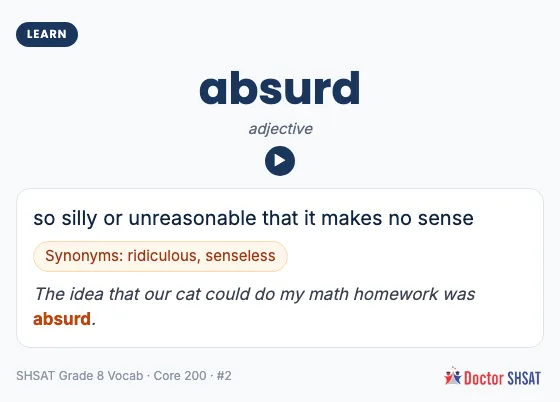
Learn the word
Hear the word spoken aloud, then flip for a plain-English meaning, synonyms and an example sentence.
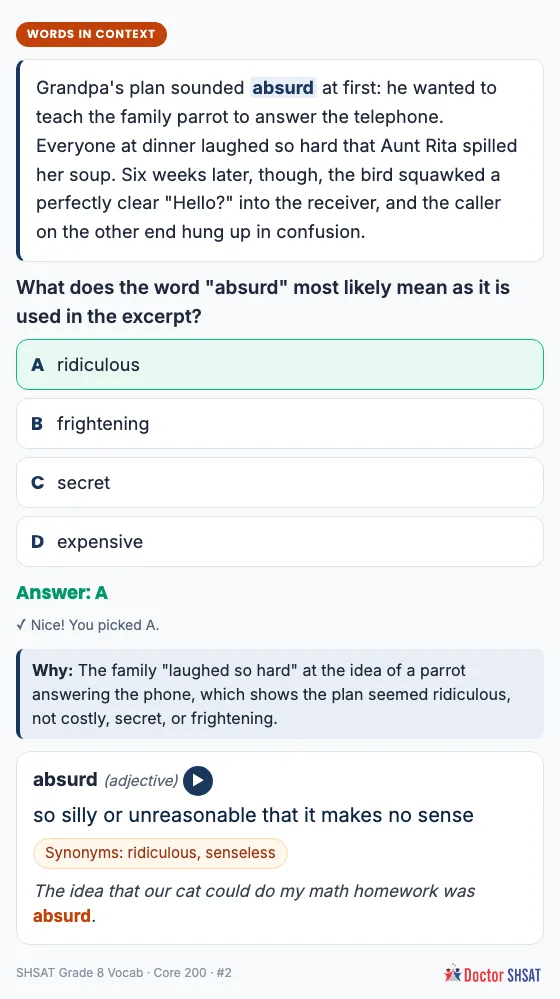
Words in context
A short passage and a “what does this word mean here?” question, just like SHSAT Reading Comprehension. Many words are used in a less familiar sense, the way the test likes to use them.
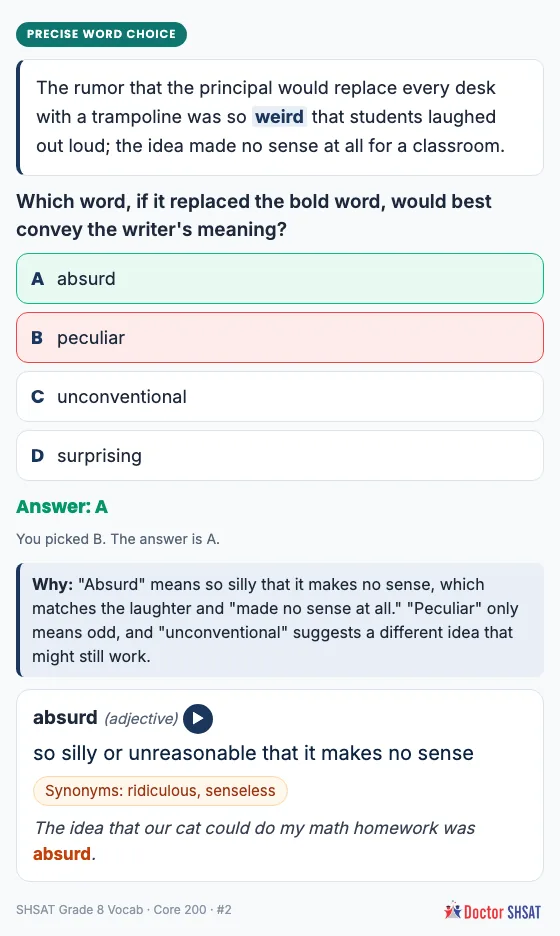
Precise word choice
Replace a vague word with the most precise one, like the word-choice questions in SHSAT Revising/Editing. The answer side explains why.
Why Vocabulary Matters on the SHSAT
The SHSAT has no separate vocabulary section, but words decide a lot of ELA points. The ELA section has 50 Revising/Editing and Reading Comprehension questions, and the Reading passages include challenging literary and informational texts. Students who stop on every unfamiliar word lose time and meaning.
Two kinds of questions test vocabulary directly: Reading Comprehension asks what a word means as it is used in a passage, and Revising/Editing asks which word makes a sentence clearer or more precise. These flashcards practice both. See the SHSAT ELA section guide for how the whole section works.
- Every question was checked. Each of the 1,000 practice questions was answered independently and checked against the answer key. Choices that could be argued as a second right answer were replaced.
- Built for 13- and 14-year-olds. Plain-English meanings and original passages on science, history, the arts and New York life.
- Spaced repetition in Anki. Each word comes back just before it would be forgotten, so 10–15 minutes a day goes a long way.
SHSAT 8th-grade Vocabulary List: All 500 Words
Every word in the deck, A to Z, with a plain-English meaning and synonyms. Start with the Core 200, then move on to the Extension 300. Prefer paper? Download the printable PDF word list.
Core 200 start here · the most useful words
- abandon v. to leave something behind for good, or to give up on a plan completely (desert, give up)
- absurd adj. so silly or unreasonable that it makes no sense (ridiculous, senseless)
- abundant adj. existing in large amounts; more than enough (plentiful, ample)
- accumulate v. to gather or pile up little by little over time (collect, build up)
- acknowledge v. to admit that something is true, or to show that you have noticed someone (admit, recognize)
- adapt v. to change to fit a new situation, or to change something so it can be used in a new way (adjust, modify)
- address v. to speak to a group, or to deal with a problem (tackle, speak to)
- advocate v. to publicly support or speak in favor of an idea or cause (champion, promote)
- ambition n. a strong desire to achieve something, often something difficult (goal, aspiration)
- anticipate v. to expect something before it happens and often get ready for it (expect, predict)
- anxious adj. worried or nervous about something that might happen (nervous, uneasy)
- apparent adj. easy to see or understand; also, seeming to be true but possibly not (obvious, seeming)
- appeal v. to make a serious request; also, to attract or interest someone (attract, request)
- appreciate v. to be thankful for something; also, to fully understand how great or important something is (value, recognize)
- assert v. to state something firmly and confidently (declare, insist)
- assume v. to suppose something is true without proof; also, to take on a role or duty (suppose, take on)
- authentic adj. real and genuine; not a copy or fake (genuine, real)
- awkward adj. clumsy or uncomfortable; also, hard to handle because of its shape (clumsy, uncomfortable)
- bear v. to carry or support the weight of something; also, to put up with something unpleasant (support, tolerate)
- benefit n. an advantage or helpful result (advantage, gain)
- bias n. an unfair preference for or against someone or something (prejudice, favoritism)
- bold adj. brave and willing to take risks; also, strong and vivid so that it stands out (daring, striking)
- brief adj. short in time or length (short, quick)
- capable adj. having the skill or power to do something (able, skilled)
- cautious adj. careful to avoid danger or mistakes (careful, wary)
- challenge v. to invite someone to try something difficult; also, to question whether something is true (question, dare)
- check v. to look at something to make sure it is right; also, to stop or slow something down (inspect, halt)
- cherish v. to love and value something or someone very deeply (treasure, adore)
- clarify v. to make something clearer or easier to understand (explain, clear up)
- collapse v. to fall down suddenly; also, to fail or break down completely (cave in, fail)
- command v. to give an order with authority; also, to have a view over something from above (order, direct)
- commit v. to promise to give your time or effort to something; also, to store something firmly in memory (pledge, dedicate)
- compel v. to force someone to do something (force, oblige)
- complex adj. made of many connected parts; complicated (complicated, intricate)
- compose v. to write music or a piece of writing; also, to calm yourself (create, calm)
- compromise n. an agreement in which each side gives up part of what it wants (deal, middle ground)
- conceal v. to hide something or keep it secret (hide, disguise)
- conclude v. to decide something after thinking about the facts; also, to end (decide, end)
- conduct v. to carry out or lead an activity; also, to let heat or electricity pass through (carry out, transmit)
- confront v. to face a problem, fear, or person directly (face, tackle)
- consequence n. a result or effect of an action or event, often an unpleasant one (result, effect)
- considerable adj. large in size, amount, or importance (significant, substantial)
- consistent adj. staying the same over time; also, agreeing with something else (steady, matching)
- consume v. to eat, drink, or use up something; also, to fill someone's mind completely (use up, absorb)
- content adj. satisfied and happy with what you have (satisfied, pleased)
- contradict v. to say or show the opposite of something (oppose, deny)
- contribute v. to give something, such as money, time, or ideas, to help a shared goal (donate, give)
- convey v. to communicate an idea or feeling; also, to carry something from one place to another (express, transport)
- cooperate v. to work together toward a shared goal (collaborate, work together)
- crucial adj. extremely important; necessary for success (essential, vital)
- cultivate v. to grow plants or crops; also, to develop a skill, habit, or friendship over time (grow, develop)
- curious adj. eager to know or learn something; also, strange or unusual (inquisitive, odd)
- decline v. to become smaller, weaker, or fewer; also, to politely refuse (decrease, refuse)
- dedicate v. to give your time and energy fully to something; also, to name someone as honored by a book, song, or building (devote, commit)
- defiant adj. boldly refusing to obey or give in (rebellious, disobedient)
- deliberate adj. done on purpose; also, slow and careful (intentional, unhurried)
- demonstrate v. to show clearly or prove; also, to show how something works (show, prove)
- dense adj. thick and tightly packed; also, packed with ideas so that it is hard to understand (thick, compact)
- depict v. to show something in a picture or describe it in words (portray, illustrate)
- desperate adj. having lost hope and willing to try anything; in extreme need (frantic, hopeless)
- determine v. to find out exactly; also, to decide or settle something (figure out, decide)
- dilemma n. a situation in which you must make a hard choice between two options (predicament, quandary)
- diminish v. to become or make smaller or less (lessen, shrink)
- distinct adj. clearly different or separate; also, easy to notice (separate, unmistakable)
- distinguish v. to see or understand the difference between things; also, to make yourself stand out (tell apart, differentiate)
- distract v. to pull someone's attention away from what they are doing (divert, sidetrack)
- diverse adj. made up of many different kinds of people or things (varied, assorted)
- dominate v. to control or have the most power over; also, to be the largest or most noticeable part of something (control, tower over)
- drastic adj. extreme, sudden, and having a strong effect (extreme, severe)
- dread n. great fear or worry about something that is going to happen (fear, apprehension)
- eager adj. wanting very much to do or have something (keen, enthusiastic)
- elaborate adj. having many carefully planned parts or details (detailed, intricate)
- eliminate v. to remove or get rid of completely (remove, eradicate)
- emerge v. to come out into view; also, to become known (appear, surface)
- emphasize v. to give special importance or attention to something (stress, highlight)
- encounter v. to meet or come across, often unexpectedly (come across, run into)
- endure v. to put up with something hard or painful; also, to last for a long time (withstand, last)
- enhance v. to improve something or make it better or stronger (improve, boost)
- enormous adj. extremely large (huge, gigantic)
- ensure v. to make certain that something happens (guarantee, make sure)
- establish v. to set up something meant to last; also, to prove that something is true (found, set up)
- evaluate v. to judge how good, useful, or valuable something is (assess, judge)
- evidence n. facts or signs that show whether something is true (proof, support)
- exaggerate v. to make something seem bigger, better, or worse than it really is (overstate, inflate)
- exclude v. to leave out or keep out (omit, bar)
- expand v. to become larger or make something larger (grow, enlarge)
- extend v. to make something longer or larger; also, to offer something to someone (lengthen, offer)
- fascinate v. to hold someone's attention by being very interesting (captivate, enthrall)
- feature n. an important or noticeable part of something; also, a special story in a newspaper or magazine (characteristic, highlight)
- firm adj. solid and not soft; also, strong and not willing to change (solid, unshakable)
- flexible adj. able to bend easily; also, able to change to fit new situations (bendable, adaptable)
- fragile adj. easily broken or damaged (delicate, breakable)
- frustrate v. to make someone annoyed because they cannot do something; also, to keep a plan from succeeding (thwart, annoy)
- generate v. to produce or create something (produce, create)
- gesture n. a movement of the hands or body that shows meaning; also, an action that shows a feeling (signal, sign)
- glimpse n. a quick look at something, often only part of it (peek, glance)
- gradually adv. slowly, a little at a time (steadily, little by little)
- grasp v. to hold something tightly; also, to understand an idea (grip, understand)
- grateful adj. thankful for something someone did (thankful, appreciative)
- grave adj. very serious and worrying (serious, solemn)
- harbor v. to give shelter or a home to; also, to keep a thought or feeling (often secret) in your mind for a long time (shelter, hold)
- hesitate v. to pause before doing or saying something because you are unsure or nervous (pause, waver)
- hostile adj. unfriendly and ready to argue or fight; also, harsh and very hard to survive in (unfriendly, harsh)
- identify v. to recognize and name who or what someone or something is (recognize, pinpoint)
- illustrate v. to make an idea clear by giving an example or demonstration; also, to add pictures to a book (demonstrate, show)
- impact n. a strong effect on someone or something; also, the force of one object hitting another (effect, collision)
- impulse n. a sudden strong wish to do something without thinking; also, a brief signal, such as one sent along a nerve (urge, signal)
- indicate v. to show, point out, or be a sign of something (show, signal)
- inevitable adj. certain to happen; impossible to avoid (unavoidable, certain)
- influence v. to have an effect on how someone thinks or acts, or on how something develops (affect, sway)
- initial adj. happening at the beginning; first (first, early)
- insist v. to say firmly that something is true or must happen, and refuse to back down (demand, maintain)
- inspire v. to fill someone with the desire or energy to do something (motivate, encourage)
- intense adj. very strong or extreme; also, (of a person) very serious and emotional about things (extreme, fierce)
- interpret v. to decide or explain what something means (understand, explain)
- investigate v. to examine something carefully to find out the truth (examine, look into)
- isolate v. to set something or someone apart from others; to separate one thing out from a mixture (separate, set apart)
- issue n. an important topic or problem that people discuss; also, a single edition of a magazine or newspaper (topic, edition)
- keen adj. eager and interested; also, sharp or highly sensitive (as in keen eyesight) (eager, sharp)
- linger v. to stay somewhere longer than expected, or to be slow to leave or disappear (remain, stay)
- maintain v. to keep something in good condition; also, to firmly state that something is true (keep up, claim)
- merely adv. only; nothing more than (only, simply)
- method n. a planned, organized way of doing something (technique, approach)
- modest adj. not bragging about yourself; also, fairly small or limited in size or amount (humble, moderate)
- motive n. a reason for doing something (reason, purpose)
- neglect v. to fail to take care of or pay attention to something (ignore, abandon)
- notion n. an idea or belief, often one that is not fully proven (idea, belief)
- novel adj. new, original, and unlike anything before (new, original)
- objective n. a goal that you are trying to reach (goal, aim)
- obstacle n. something that blocks the way or makes progress difficult (barrier, hurdle)
- obtain v. to get something, usually through effort (get, acquire)
- oppose v. to be against something and try to stop it (resist, object to)
- origin n. the point where something begins or comes from; the source (source, beginning)
- persist v. to keep doing something despite difficulty; also, to continue to exist (continue, persevere)
- perspective n. a point of view; a way of seeing or thinking about something (viewpoint, outlook)
- persuade v. to convince someone to do or believe something by giving reasons (convince, talk into)
- plain adj. simple and without decoration; also, easy to see or understand; obvious (simple, obvious)
- precise adj. exact and accurate, with careful attention to detail (exact, accurate)
- predict v. to say what will happen in the future, often based on evidence (forecast, foresee)
- preserve v. to keep something safe from harm or decay, or in its original state (protect, save)
- primary adj. main or most important; also, first in order or time (main, chief)
- principle n. a basic rule or truth; also, a belief about right and wrong that guides behavior (rule, value)
- proceed v. to go forward or continue, often after a pause (continue, advance)
- profound adj. very deep or great, especially in feeling, meaning, or effect (deep, powerful)
- prohibit v. to forbid something by rule or law (forbid, ban)
- prominent adj. important and well known; also, sticking out so that it is easy to see (noticeable, famous)
- prompt v. to cause or encourage someone to do something (spur, trigger)
- propose v. to suggest a plan or idea for others to consider (suggest, put forward)
- prospect n. the possibility that something will happen in the future (possibility, outlook)
- provoke v. to cause a strong reaction, especially anger, often on purpose (anger, stir up)
- pursue v. to chase or follow; also, to work steadily toward a goal (chase, strive for)
- rational adj. based on clear thinking and good reasons; sensible and logical (logical, sensible)
- reassure v. to say or do something to make someone feel less worried (comfort, calm)
- recall v. to remember; also, (of a company) to ask people to return a product because it is unsafe (remember, call back)
- recover v. to get well again; also, to get back something that was lost or taken (heal, retrieve)
- reflect v. to throw back light or an image, like a mirror; also, to think carefully about something (mirror, consider)
- reinforce v. to make something stronger; also, to support or strengthen an idea (strengthen, support)
- reject v. to refuse to accept, use, or believe something (refuse, turn down)
- relevant adj. closely connected to the subject being discussed (related, pertinent)
- reluctant adj. unwilling or hesitant to do something (unwilling, hesitant)
- remedy n. a cure for an illness; also, a solution to a problem (cure, solution)
- remote adj. far away from other places; also, very slight or small (as in a remote chance) (distant, slight)
- resemble v. to look like or be similar to (look like, mirror)
- resent v. to feel angry or bitter about something you think is unfair (begrudge, be bitter about)
- resist v. to fight against or refuse to give in to something; also, to hold up against damage (withstand, oppose)
- resolve v. to settle or solve a problem; also, to decide firmly to do something (settle, decide)
- resource n. a supply of something useful, such as water, money, or information (supply, asset)
- restore v. to bring something back to its original condition (repair, renew)
- restrict v. to keep something within limits (limit, confine)
- retreat v. to move back or away, often from danger (withdraw, pull back)
- reveal v. to show or make known something that was hidden or secret (uncover, disclose)
- rigid adj. stiff and unable to bend; also, strict and unwilling to change (stiff, strict)
- scarce adj. hard to find because there is not enough (rare, in short supply)
- seek v. to look for or try to get something (search for, pursue)
- significant adj. important or large enough to be noticed or to matter (important, considerable)
- skeptical adj. doubtful; not easily convinced that something is true (doubtful, unconvinced)
- solitary adj. alone; living, being, or done without others (lone, alone)
- sound adj. healthy and in good condition; also, based on good reasoning and reliable (solid, sensible)
- spontaneous adj. happening naturally, without being planned (unplanned, impulsive)
- stable adj. steady and firm; not likely to fall, shake, or change (steady, secure)
- strategy n. a careful plan for reaching a goal (plan, approach)
- strike v. to hit with force; also, to suddenly come into someone's mind or catch their attention (hit, impress)
- subtle adj. not obvious; small and hard to notice (slight, faint)
- sufficient adj. enough for a particular purpose (enough, adequate)
- suppress v. to hold back or stop something, such as a feeling or a fire (hold back, put down)
- sustain v. to keep something going or support it; also, to suffer an injury or loss (maintain, suffer)
- tension n. a nervous, strained feeling; also, how tightly something is stretched (strain, stress)
- thrive v. to grow strongly and healthily; to do very well (flourish, prosper)
- trait n. a quality that is part of someone's character or of a living thing (quality, characteristic)
- transform v. to change something completely in form or character (convert, change completely)
- triumph n. a great victory or success (victory, success)
- typical adj. normal or usual for a particular person, group, or thing (usual, normal)
- ultimately adv. in the end; finally, after everything else (finally, eventually)
- undergo v. to experience or go through something, such as a change or a test (go through, experience)
- unique adj. one of a kind; unlike anything else (one of a kind, distinctive)
- urge v. to strongly encourage or advise someone to do something (encourage, press)
- vague adj. unclear or not specific (unclear, fuzzy)
- venture v. to go somewhere risky or unknown; also, to dare to say something (dare, risk)
- vivid adj. very bright and strong; also, (of a memory or description) very clear and detailed (bright, clear)
- yield v. to produce something, such as a crop or result; also, to give way to others (produce, give way)
Extension 300 tap to show · harder words for higher scores
- abrupt adj. sudden and unexpected; also short and unfriendly in the way someone speaks (sudden, curt)
- abstract adj. existing as an idea rather than a physical object; in art, not showing real people or things (conceptual, nonrepresentational)
- accommodate v. to make room for; to adjust in order to meet someone's needs (hold, adapt to)
- account n. a description or report of an event; also a record of money (report, description)
- adversity n. great difficulty or hardship (hardship, misfortune)
- affluent adj. having a lot of money; wealthy (wealthy, prosperous)
- agitate v. to make someone nervous or upset; to stir or shake a liquid (disturb, stir)
- alleviate v. to make pain or a problem less severe (ease, relieve)
- allude v. to mention something indirectly, without saying it plainly (hint at, refer to)
- anonymous adj. having no known name; not identified (unnamed, unidentified)
- arbitrary adj. based on chance or personal whim rather than on a reason (random, unreasoned)
- articulate v. to express an idea or feeling clearly in words (express, voice)
- aspire v. to hope strongly to achieve something (strive, aim)
- austere adj. plain and without comfort or decoration; strict and serious (bare, stern)
- avert v. to prevent something bad from happening; to turn away (one's eyes) (prevent, turn away)
- banish v. to force someone to leave a place; to get rid of something (exile, expel)
- benevolent adj. kind and wanting to help others (kind, charitable)
- betray v. to be disloyal to; to reveal something without meaning to (double-cross, reveal)
- bewilder v. to confuse someone completely (baffle, puzzle)
- blunt adj. saying something directly without trying to be polite; not sharp (frank, dull)
- candid adj. open and honest, even about uncomfortable things (frank, honest)
- capacity n. the most that something can hold; ability; a role or position (volume, role)
- catastrophe n. a sudden event that causes great damage or suffering; a disaster (disaster, calamity)
- cease v. to stop (stop, halt)
- champion v. to support or fight for a cause or person (support, advocate)
- chronic adj. lasting a long time or happening again and again (persistent, long-lasting)
- clamor n. a loud, confused noise; a strong public demand (uproar, outcry)
- coax v. to gently persuade someone to do something (persuade, sweet-talk)
- coherent adj. clear and logical, so that the parts fit together (logical, clear)
- coincide v. to happen at the same time; to match or agree (coincide, overlap)
- commence v. to begin or start (begin, start)
- compassion n. sympathy and concern for people who are suffering (sympathy, kindness)
- compatible adj. able to work or exist together without problems (matching, well-suited)
- compensate v. to pay someone for a loss or for work; to make up for something (repay, make up for)
- complacent adj. too pleased with oneself to notice danger or try harder (self-satisfied, smug)
- comply v. to obey a rule, order, or request (obey, follow)
- comprehensive adj. including everything or nearly everything; thorough (thorough, complete)
- conceive v. to form an idea in the mind; to imagine (imagine, think up)
- condemn v. to express strong disapproval of; to declare a building unfit for use (denounce, criticize)
- confide v. to tell someone a secret because you trust them (entrust, share privately)
- conform v. to follow accepted rules or behave the same way as others; to match a standard (comply, fit in)
- consensus n. general agreement among a group (agreement, accord)
- consolidate v. to combine several things into one; to make stronger or more secure (combine, merge)
- contend v. to argue that something is true; to compete; to deal with a problem (compete, claim)
- contrary adj. opposite in direction or meaning; stubbornly doing the opposite of what is wanted (opposite, stubborn)
- conventional adj. following usual or traditional ways; ordinary (traditional, customary)
- conviction n. a firmly held belief; a court's finding that someone is guilty (belief, certainty)
- cordial adj. warm, friendly, and polite (friendly, gracious)
- credible adj. believable; able to be trusted (believable, trustworthy)
- credit v. to say that someone deserves recognition for something; to believe (recognize, attribute)
- cumbersome adj. large, heavy, or awkward and hard to carry; slow and complicated (awkward, unwieldy)
- deceive v. to make someone believe something that is not true (trick, mislead)
- decisive adj. settling a question or contest; able to make choices quickly and firmly (conclusive, resolute)
- defer v. to put off until later; to give way to someone else's judgment (postpone, yield)
- deficient adj. lacking something that is needed; not good enough (lacking, inadequate)
- degrade v. to break down or become worse in quality; to treat someone without respect (deteriorate, humiliate)
- deplete v. to use up a supply of something (exhaust, drain)
- deprive v. to take something away from someone or keep them from having it (deny, strip)
- deride v. to make fun of in a scornful way (mock, ridicule)
- derive v. to get something from a source (obtain, draw)
- designate v. to officially choose someone or something for a purpose or name (appoint, assign)
- despise v. to dislike very strongly; to hate (hate, loathe)
- deter v. to discourage or prevent someone from doing something (discourage, prevent)
- devastate v. to destroy completely; to make someone extremely sad (wreck, crush)
- devise v. to plan or invent something, especially something clever (invent, design)
- dignity n. the quality of deserving respect; a calm, serious manner (self-respect, honor)
- diligent adj. working hard and carefully (hardworking, careful)
- discard v. to throw away something no longer wanted (throw away, dump)
- discern v. to notice or recognize something that is hard to see or understand (detect, make out)
- discord n. disagreement between people; harsh, clashing sounds (conflict, dissonance)
- dismal adj. gloomy and depressing; very poor in quality (gloomy, dreadful)
- dismay n. a feeling of shock and disappointment (distress, alarm)
- dispatch v. to send someone or something off quickly for a purpose (send, deploy)
- disperse v. to scatter or spread out in different directions (scatter, disband)
- dispute n. a disagreement or argument (disagreement, quarrel)
- disrupt v. to interrupt or disturb the normal course of something (interrupt, disturb)
- dissolve v. to mix into a liquid and disappear; to officially end a group or agreement (melt, break up)
- distort v. to twist out of shape; to change facts so they are misleading (warp, misrepresent)
- divert v. to change the direction of something; to draw attention away (redirect, distract)
- docile adj. calm, gentle, and easy to control (gentle, obedient)
- dormant adj. inactive for a time but able to become active again (inactive, sleeping)
- dubious adj. doubtful; probably not true or trustworthy (doubtful, questionable)
- durable adj. able to last a long time without breaking or wearing out (sturdy, long-lasting)
- eccentric adj. strange or unusual in behavior, often in a harmless way (odd, quirky)
- eloquent adj. speaking or writing in a clear, powerful, and moving way (expressive, articulate)
- elusive adj. hard to find, catch, or understand (hard to catch, slippery)
- embark v. to board a ship or plane; to begin something new or important (begin, set out)
- empathy n. the ability to understand and share another person's feelings (understanding, fellow feeling)
- enact v. to make into law; to act out a story or role (pass, perform)
- endeavor n. a serious attempt to do something difficult (effort, undertaking)
- engage v. to take part in; to hold someone's attention; to hire (involve, occupy)
- enigma n. a person or thing that is mysterious and hard to understand (mystery, puzzle)
- entice v. to attract someone by offering something pleasant (tempt, attract)
- envision v. to picture something in your mind, especially something in the future (imagine, picture)
- erode v. to wear away slowly; to weaken gradually (wear away, weaken)
- erratic adj. not regular or predictable; changing suddenly (unpredictable, irregular)
- esteem n. respect and admiration (respect, regard)
- evade v. to avoid or escape someone or something, often by being clever (avoid, dodge)
- evoke v. to bring a feeling, memory, or image to mind (summon, call up)
- exasperate v. to annoy or frustrate someone very much (infuriate, frustrate)
- exceed v. to go beyond a limit or amount; to be greater than (surpass, top)
- exempt adj. free from a rule, duty, or payment that applies to others (excused, spared)
- exert v. to put forth effort, force, or influence (apply, use)
- exploit v. to make full use of something; also, to take unfair advantage of someone or something (utilize, take advantage of)
- extract v. to pull or take something out, often with effort (remove, draw out)
- fabricate v. to make up something false; also, to build or manufacture (invent, construct)
- facilitate v. to make an action or process easier (ease, assist)
- falter v. to lose strength or confidence; to hesitate or stumble (waver, stumble)
- fashion v. to make or shape something, often by hand (shape, craft)
- feasible adj. possible to do; practical (workable, practical)
- feeble adj. weak; lacking strength or force (weak, frail)
- fervent adj. showing strong, passionate feeling (passionate, intense)
- fickle adj. changing one's mind or loyalty often; unpredictable (changeable, unpredictable)
- flaw n. a mistake, weakness, or imperfection (defect, fault)
- fluctuate v. to rise and fall or change back and forth irregularly (vary, swing)
- formidable adj. causing fear or respect because of being large, powerful, or difficult (intimidating, imposing)
- foster v. to encourage the growth or development of something; also, to care for a child or animal temporarily (encourage, nurture)
- frantic adj. wildly anxious, hurried, or out of control because of fear or worry (panicked, frenzied)
- frugal adj. careful not to waste money or resources (thrifty, economical)
- futile adj. having no useful result; pointless (useless, hopeless)
- gauge v. to measure something; also, to judge or estimate (judge, measure)
- grueling adj. extremely tiring and demanding (exhausting, punishing)
- gullible adj. easily tricked because of believing things too quickly (naive, trusting)
- haphazard adj. lacking any plan or order; random (random, disorganized)
- hardy adj. strong and able to survive difficult conditions (tough, rugged)
- hinder v. to get in the way of; to make something harder to do (obstruct, hamper)
- hypothesis n. an educated guess that can be tested (theory, proposal)
- idle adj. not working or being used; also, having no real purpose or basis (inactive, unused)
- illuminate v. to light up; also, to make something clearer or easier to understand (clarify, light up)
- immerse v. to put completely under a liquid; also, to involve oneself deeply in an activity (absorb, submerge)
- impair v. to weaken or damage something, making it work less well (damage, weaken)
- impartial adj. fair; not favoring one side over another (fair, unbiased)
- implement v. to put a plan or decision into action (carry out, execute)
- implore v. to beg someone urgently and emotionally (beg, plead with)
- imply v. to suggest something without saying it directly (suggest, hint)
- improvise v. to make up or create something on the spot without planning (ad-lib, make do)
- incentive n. something that encourages a person to do something (motivation, reward)
- incessant adj. continuing without stopping (constant, nonstop)
- inclined adj. likely or wanting to do something; also, sloping or tilted (likely, tilted)
- incorporate v. to include something as part of a whole (include, integrate)
- indifferent adj. not caring or not interested (uninterested, unconcerned)
- indignant adj. angry because something seems unfair (offended, resentful)
- induce v. to cause something to happen; also, to persuade someone to do something (cause, persuade)
- infer v. to figure something out from clues or evidence (conclude, deduce)
- inhabit v. to live in a place (occupy, dwell in)
- inhibit v. to hold back or slow down a process or action (restrain, suppress)
- initiate v. to start or begin something (begin, launch)
- innate adj. existing from birth; natural rather than learned (inborn, natural)
- innovation n. a new idea, method, or invention (invention, breakthrough)
- insight n. a clear, deep understanding of something (understanding, perception)
- integrity n. the quality of being honest and having strong moral principles; also, the state of being whole and sound (honesty, soundness)
- intervene v. to step in to change or stop what is happening (step in, interfere)
- intimidate v. to frighten someone, especially to make them do or not do something (frighten, scare)
- intrigue v. to make someone very curious or interested (fascinate, interest)
- intuition n. the ability to know or understand something without proof or reasoning; a gut feeling (instinct, hunch)
- invaluable adj. extremely useful; so valuable that it cannot be measured (priceless, essential)
- irritable adj. easily annoyed or made angry (grumpy, cranky)
- jeopardy n. danger of loss, harm, or failure (danger, risk)
- jubilant adj. extremely happy and excited, especially after a success (overjoyed, elated)
- justify v. to show or prove that something is right or reasonable (defend, explain)
- lament v. to express sadness or regret about something (mourn, regret)
- lavish adj. rich, expensive, or generous in amount; more than enough (extravagant, generous)
- legitimate adj. allowed by law or rules; also, reasonable and justified (valid, lawful)
- lenient adj. not strict; gentle in punishing or judging (easygoing, forgiving)
- liberate v. to set free (free, release)
- lucrative adj. producing a lot of money or profit (profitable, moneymaking)
- malicious adj. intending to hurt or cause harm (spiteful, cruel)
- mandatory adj. required by a rule or law (required, compulsory)
- mediate v. to help two sides settle a disagreement (referee, negotiate)
- misconception n. a mistaken idea or belief (misunderstanding, myth)
- mobilize v. to organize and prepare people or resources for action (rally, assemble)
- morale n. the confidence, enthusiasm, and spirit of a person or group (spirit, confidence)
- mundane adj. ordinary and dull; part of everyday life (ordinary, routine)
- muster v. to gather or call up something, such as courage or strength; also, to assemble a group (summon, gather)
- mutual adj. shared or felt by two or more people toward each other (shared, joint)
- myriad adj. countless; extremely many (countless, numerous)
- naive adj. lacking experience, so too trusting or simple in judgment (inexperienced, innocent)
- negligible adj. so small or unimportant that it is not worth considering (tiny, insignificant)
- nimble adj. quick and light in movement; also, quick in thinking (agile, quick)
- nostalgia n. a warm, slightly sad longing for the past (longing, wistfulness)
- notorious adj. well known for something bad (infamous, disreputable)
- oblivious adj. not aware of what is happening around you (unaware, unmindful)
- obscure adj. not well known; also, unclear or hard to understand (little-known, unclear)
- obsolete adj. no longer used because something newer has replaced it (outdated, out of date)
- ominous adj. suggesting that something bad is about to happen (threatening, menacing)
- opaque adj. not letting light through; also, hard to understand (cloudy, unclear)
- optimism n. hopefulness and confidence that things will turn out well (hopefulness, positivity)
- ornate adj. decorated with lots of complicated detail (elaborate, fancy)
- overwhelm v. to be too much for someone to handle; also, to defeat completely by greater force (overpower, swamp)
- pacify v. to calm someone who is angry or upset (calm, soothe)
- painstaking adj. done with great care and attention to every detail (meticulous, thorough)
- paradox n. a statement or situation that seems impossible or contradictory but may be true (contradiction, puzzle)
- passive adj. accepting what happens without reacting or taking action (inactive, submissive)
- peculiar adj. strange or unusual; also, belonging only to one person, place, or thing (odd, distinctive)
- penetrate v. to go into or through something; also, to understand something difficult (pierce, break through)
- perceive v. to notice or become aware of something; also, to think of or regard something in a certain way (notice, regard)
- peril n. serious and immediate danger (danger, hazard)
- perish v. to die or be destroyed, especially in a sudden or violent way (die, be destroyed)
- pessimistic adj. expecting that bad things will happen (gloomy, negative)
- phenomenon n. an event or fact that can be observed, especially an unusual one (occurrence, event)
- plausible adj. seeming reasonable or likely to be true; believable (believable, reasonable)
- plead v. to beg someone in an emotional way; also, to give something as an excuse or to answer a charge in court (beg, appeal)
- plight n. a difficult, sad, or dangerous situation (predicament, hardship)
- poignant adj. causing a strong feeling of sadness or tenderness; deeply moving (moving, touching)
- ponder v. to think about something carefully for a long time (consider, contemplate)
- potent adj. having great power or a strong effect (powerful, strong)
- practical adj. sensible and useful in real life rather than fancy or just for show (sensible, useful)
- precaution n. something you do ahead of time to prevent harm or trouble (safeguard, safety measure)
- precede v. to come before something in time or order (come before, lead up to)
- prejudice n. an unfair opinion about a person or group formed without knowing the facts (bias, unfairness)
- prestige n. the respect and admiration something earns because of its success or importance (status, reputation)
- presume v. to suppose something is true without proof (assume, suppose)
- prevail v. to win or prove stronger; also, to be common or widespread (triumph, win)
- prior adj. coming before in time; earlier (previous, earlier)
- procrastinate v. to keep putting off something you should do (delay, stall)
- proficient adj. skilled and good at something because of practice (skilled, capable)
- prolong v. to make something last longer (extend, lengthen)
- proportion n. a part compared with the whole; also, the correct size of parts compared with each other (share, balance)
- provision n. the act of supplying something; supplies (provisions); also, a condition written into an agreement (supply, condition)
- prudent adj. wise and careful, especially about the future (wise, sensible)
- radiant adj. shining brightly; also, glowing with happiness (glowing, beaming)
- rash adj. done too quickly without thinking about what might happen (hasty, impulsive)
- recede v. to move back or away; also, to grow fainter or less (retreat, fade)
- reckless adj. not caring about danger or what might happen (careless, daring)
- reconcile v. to become friends again after a disagreement; also, to make two things agree or fit together (make up, harmonize)
- recur v. to happen again, often more than once (repeat, return)
- refine v. to improve something by making small changes; also, to make something pure (polish, purify)
- refrain v. to stop yourself from doing something (hold back, abstain)
- refute v. to prove that a statement or idea is wrong (disprove, rebut)
- register v. to sign up officially; also, to be noticed or understood, or to show a feeling (enroll, sink in)
- relentless adj. never stopping or easing up (constant, unceasing)
- relinquish v. to give up or let go of something (surrender, give up)
- remorse n. deep regret for something wrong you have done (regret, guilt)
- renowned adj. famous and admired by many people (famous, celebrated)
- replenish v. to fill something up again (refill, restock)
- reprimand v. to scold someone officially for doing something wrong (scold, rebuke)
- reserve n. a supply kept for later; also, a quiet, self-controlled way of behaving (stockpile, restraint)
- resilient adj. able to recover quickly from hard times or damage (tough, adaptable)
- resolute adj. firmly determined; not giving up (determined, steadfast)
- retain v. to keep or hold on to something (keep, hold)
- retaliate v. to strike back after being attacked or treated badly (strike back, get even)
- revere v. to deeply respect and admire (honor, worship)
- revise v. to change something to correct or improve it (edit, update)
- rigorous adj. very thorough, careful, and strict (thorough, strict)
- robust adj. strong and healthy; also, rich and full in flavor (sturdy, hearty)
- rouse v. to wake someone up; also, to stir up strong feeling or excitement (awaken, stir up)
- rudimentary adj. very basic or simple; at an early stage (basic, elementary)
- ruthless adj. having no pity or mercy for others (merciless, harsh)
- sabotage v. to damage or block something on purpose (undermine, wreck)
- salvage v. to save something from being lost or destroyed (rescue, recover)
- sanctuary n. a safe, peaceful place where someone can find protection or rest; also, a protected area for wildlife (refuge, haven)
- savor v. to enjoy something slowly and fully; also, to taste and enjoy food (relish, enjoy)
- serene adj. calm, peaceful, and untroubled (calm, tranquil)
- shrewd adj. clever and good at judging situations to get an advantage (sharp, astute)
- solemn adj. serious, quiet, and respectful (serious, grave)
- spare adj. extra and kept in case it is needed; also, plain, simple, or using very little (extra, plain)
- speculate v. to guess or form ideas about something without having all the facts (guess, theorize)
- squander v. to waste something, such as money, time, or a chance (waste, throw away)
- stagnant adj. not flowing or moving; also, not growing or changing (still, inactive)
- stamina n. the strength to keep doing something hard for a long time (endurance, staying power)
- steep adj. rising or falling sharply; also, much too high in price (sharp, excessive)
- stem v. to stop or hold back the flow of something; also (stem from) to come from (stop, check)
- stern adj. serious and strict, often in a way that seems unfriendly (strict, severe)
- stifle v. to hold back or stop something, like a laugh, a yawn, or an idea (suppress, smother)
- stimulate v. to encourage something to become more active or to grow (encourage, spur)
- stir v. to mix by moving a spoon around; also, to awaken a feeling or memory (mix, awaken)
- stringent adj. very strict and demanding about following rules (strict, rigid)
- stubborn adj. refusing to change your mind or do what others want; also, hard to remove or fix (obstinate, persistent)
- subside v. to become less strong or intense; to calm down (lessen, ease)
- succumb v. to give in to something you have been fighting against (give in, yield)
- summon v. to call someone to come; also, to gather up a quality such as courage (call, gather)
- superficial adj. only on the surface; not deep or thorough (shallow, surface-level)
- supplement v. to add something extra to make something more complete (add to, boost)
- susceptible adj. easily affected or harmed by something (vulnerable, prone)
- tactful adj. careful to say things in a way that does not hurt or offend people (diplomatic, considerate)
- tedious adj. long, slow, and boring (dull, tiresome)
- temper v. to make something softer or less extreme (soften, moderate)
- temperament n. a person's or animal's usual nature or personality (personality, disposition)
- tenacious adj. holding on firmly; refusing to give up (persistent, determined)
- tentative adj. not certain or final; also, done in a hesitant, unsure way (uncertain, hesitant)
- terminate v. to bring something to an end (end, stop)
- tolerate v. to put up with or survive something difficult; to allow (endure, put up with)
- transition n. a change from one state, place, or stage to another (shift, changeover)
- transparent adj. clear enough to see through; also, so obvious that it fools no one (clear, obvious)
- treacherous adj. full of hidden dangers; also, not loyal (dangerous, disloyal)
- trivial adj. small and unimportant (minor, petty)
- turmoil n. a state of great confusion, disorder, or upset (chaos, uproar)
- unanimous adj. agreed to by everyone (united, undivided)
- uncanny adj. strange in a way that is hard to explain; remarkably close or exact (eerie, remarkable)
- unravel v. to undo threads that are knitted or woven; also, to solve or explain something complicated (untangle, solve)
- uphold v. to support or keep something; also, to confirm that an earlier decision was correct (support, confirm)
- utilize v. to use something, especially in a practical or effective way (use, employ)
- valiant adj. showing great courage (brave, heroic)
- versatile adj. able to do many different things or be used in many ways (adaptable, all-around)
- vigilant adj. carefully watching for danger or problems (watchful, alert)
- vigorous adj. strong, energetic, and full of force (energetic, forceful)
- vulnerable adj. easily hurt or attacked; not protected (defenseless, exposed)
- withdraw v. to take something out or back; also, to pull away from other people (remove, retreat)
- wither v. to dry up and shrink; also, to lose confidence or strength (shrivel, wilt)
- zeal n. great energy and eagerness for something (enthusiasm, passion)
How to Use the Flashcards
Anki (recommended)
- Install Anki: free on Mac and PC from apps.ankiweb.net, free AnkiDroid on Android, or AnkiMobile on iPhone and iPad.
- Download the deck and double-click the file (or use File → Import).
- Start with 1 · Core 200. Ten new words a day is plenty.
- Do the day’s reviews every day. That is the habit that makes words stick.
Quizlet
- Download the Quizlet sets and unzip them.
- In Quizlet, choose Create → Flashcard set → Import.
- Paste one file and set the separators to Tab and New line.
- Repeat for each set. Use Learn mode on the Core 200 first.
A simple plan: 10 new words a day, five days a week, covers the Core 200 in four weeks and all 500 words in ten.
Free SHSAT Vocabulary for 8th and 9th Grade
1,000 words in total, with no repeats between the decks.
8th-Grade SHSAT Deck
500 words for 8th graders applying to 9th grade.
You are here.
SHSAT Vocabulary Flashcards: Questions
Are the SHSAT vocabulary flashcards really free?
Yes. The Anki deck, the Quizlet sets and the PDF word list are all free, with no sign-up and no email required. Share them with any family preparing for the SHSAT.
Which deck should my child use?
This deck is for 8th graders taking the SHSAT for 9th-grade admission. If your child is in 9th grade and taking the 9th-grade SHSAT, use the 9th-grade deck, which has 500 harder words and no repeats.
Does the SHSAT have a vocabulary section?
No. The SHSAT has no separate vocabulary, synonym or analogy questions. Vocabulary is tested inside the ELA section: Reading Comprehension asks what a word means as it is used in a passage, and Revising/Editing asks which word makes a sentence most precise. These flashcards practice exactly those two question styles.
Is this the official SHSAT 8th-grade word list?
No. NYC Public Schools does not publish a vocabulary list for the SHSAT. These 500 words were chosen by Dr. Stuart Donnelly as the words 8th graders most often meet in SHSAT-level reading passages and need for precise word choice.
Is there a printable SHSAT vocabulary list (PDF)?
Yes. Download the free PDF word list: all 500 words with meanings and synonyms, split into the Core 200 and the Extension 300.
How do I open the Anki deck?
Install the free Anki app on a Mac or PC (apps.ankiweb.net), or AnkiDroid on Android, or AnkiMobile on iPhone and iPad. Then double-click the .apkg file, or use File → Import in Anki. Audio, fonts and styling are built in.
How do I use the Quizlet version?
Unzip the download. It contains six text files and a short how-to. In Quizlet choose Create → Flashcard set → Import, paste one file, set the separators to Tab and New line, and click Import.
How many words a day should my child learn?
About 10 new words a day, five days a week, finishes the Core 200 in four weeks and all 500 in ten. Anki brings each word back just before it would be forgotten, so 10–15 minutes a day is enough.
Flashcards Build the Words. Tutoring Builds the Score.
Dr. Donnelly teaches the strategies behind every SHSAT ELA and Math question type, online or in person in NYC.
Schedule Free Consultation